



Development of a MARC-compliant Historical Institutional Photo Database for the Hungarian University of Fine Arts.
Development of a MARC-compliant Historical Institutional Photo Database for the Hungarian University of Fine Arts.


With this cultural tourism app, our aim is to provide our customers with a tool to easily and quickly design and publish thematic tours or virtual walks of local values and cultural treasures.
Spreading local and cultural knowledge in an engaging way
Game modes
Administration interface
With the app, you can create any number of thematic walks without any restrictions: city walks, themed tours around a specific event or celebrity, a competition for students – unleash your creativity! During the walk, the presentation of spectacular places can be enriched with interesting content, we can engage the audience with quizzes and invite the whole family to play games. In addition to individual play mode, you can also compete, so a whole class or group can join in. Using the capabilities of the mobile device, the app sends information or guides the user to the next point in the game based on their physical location. On a desktop computer or in a web browser, it presents the points of interest in a virtual tour.
An administration interface is available for editing the walks after logging in. As the very first step, attractions have to be recorded together with their descriptions and associated media. These recorded items will serve as each ‘stop’ while creating guided tours and quiz-enriched playful walks. One stop can of course be used for several walks.
In addition to creating outdoor tours, the app is also suitable for creating an indoor media (or audio-only) tour guide service based on QR codes.
Qulto Attract components are offered as a cloud service, installed on the servers of Qulto. The service includes server hosting (monitoring, backup), hosting and software usage.
Applications are web-based, running in a standard browser, with responsive design. The administration interfaces is also accessible from the browser.
In case of termination of the contract, the content created by the customer will be made available in a viewable format, without any additional charge. This will not include interaction elements offered by the application and the possibility of navigating between the pages.
The applications are run as cloud services, and our company takes care of the storage and serving of data, and of the operation of server-side programs. To answer technical questions and troubleshoot any technical issues that may arise, our company operates a support service. The visitor interfaces are browser-based and, thus can be accessed from a variety of workstations and mobile devices. The use of CityConquest is independent of any collection management system used by the institution.
On-line consultation is included as part of the purchase for all applications. The administrator interfaces are simple, easy to use, and working with them does not require any preliminary training or IT skills other than the ones used for everyday work.


Our Qulto Repo service is based on one of the world’s most popular open-source repository software, DSpace. Our solution, built on the latest version, is not just a digital warehouse, but an intelligent information ecosystem that supports institutional visibility and the principles of Open Science at the highest level. The DSpace repository has gained great popularity in recent years, primarily among public education and public collection institutions. It has earned its popularity mainly through its relative ease of use, customizability, and maintainability.
The goal of repository implementations is to provide storage for uploaded media (text documents, images, videos, audio files), ensuring the legally compliant publication of content, whether it be Open Access or restricted-access documents. The service interface is usually the public collection’s public catalog (OPAC3). Upon request, individual repositories can also be used independently. With the help of this module, your institution can easily manage its digital content. Standard descriptive elements can be attached to all content, helping searchability and providing interoperability between different systems. Our solution also supports full-text indexing and searching.
In addition to DSpace’s core functions related to the repositioning of digital objects, Qulto Repo features add-ons such as media display and video playback implemented by Qulto developers. Furthermore, it provides integration with other elements of the Qulto Platform, such as the Opac common search engine, so that institutional content becomes an integral part of the library catalog. Additionally, it serves as a publication platform for the Qulto Digitize service, for the purpose of publishing digital content created by Qulto Digitize iself.
Through our Silver DSpace Registered Service Provider (RSP) status, as internationally recognized experts, we are in direct contact with the DSpace developer community. For our clients, this means guaranteed security, up-to-date updates, and compliance with international standards.


Qulto Digitize is a mass digitisation framework that provides solution for public collections, the general public and individual users as well for collaborative processing, grouping and repository management of text and image content. The main advantage of the framework is that it eliminates the need for both the use of other software and applications, and the cumbersome movement of files to be processed. Besides, it enables multi-user workflows.
Our module allows you to create, register, manage and share digital assets and their associated metadata with broad range of audiences. Furthermore, it also provides secure storage of master files, creation of on-demand converted versions, optical character recognition (OCR), watermarking and digital rights management (DRM) of files.
We support the digitisation of books, journals and analogue copies with workflows that make the collaborative work of consortium members transparent. Our system also provides a tool to manage the division of labour and the sharing of income and costs. Digitize is able to export and import METS-compliant digital objects and their metadata; we support digitisation processes with character recognition software; and detailed digitisation allows users to create independent e-documents from pieces of complete works. We can also record legal information and provide digital protection (DRM) for the works. Our system includes native, master and original files, the latter being generated automatically.
Groups of people working with digital objects – let them be university work groups, teachers, e-learning professionals or researcher – need an online platform where they can work on packages of files together in a way that will require them to move those files as infrequently as possible.
For more details and registration visit here!


The Q360 application is a spherical panoramic virtual exhibition and walk through in a web environment with a responsive design. By creating 360 degree spherical panoramic virtual exhibitions and virtuals walks, you can digitally create or archive exhibition spaces. Using marker points placed on spherical panoramic images, you can place details from the real space in the virtual space and even complete it with additional, extra information. This way we can tell and show more about the objects than we could in a simple physical space.
Interfaces
In the administration interface of the application, it is possible to create virtual exhibitions and to define spherical panoramic images, so-called scenes, in these exhibitions without any additional help. Marker points placed on the scenes can be used both to transfer knowledge, information, and to navigate between scenes within the virtual exhibition.
The visitor interface is the main element of the application, where visitors can view a virtual exhibition. Here, it is possible to navigate between the scenes (i.e. spherical panoramic images) of the virtual exhibition, and by clicking on marker points to view the textual and visual information assigned to the scenes. A spherical panoramic image of a scene can also be viewed using VR glasses (Oculus Rift). For instance, a museum with several rooms can be presented in such a way that each room is a separate scene, but for larger rooms, multiple scenes can be defined as well. The visual information displayed in the scenes is not bound to physical space.
Administration interface:
Visitor interface:
What to use it for?
Qulto Attract components are offered as a cloud service, installed on the servers of Qulto. The service includes server hosting (monitoring, backup), hosting and software usage.
Applications are web-based, running in a standard browser, with responsive design. The administration interfaces is also accessible from the browser.
In case of termination of the contract, the content created by the customer will be made available in a viewable format, without any additional charge. This will not include interaction elements offered by the application and the possibility of navigating between the pages.
The applications are run as cloud services, and our company takes care of the storage and serving of data, and of the operation of server-side programs. To answer technical questions and troubleshoot any technical issues that may arise, our company operates a support service. The visitor interfaces are browser-based and, thus can be accessed from a variety of workstations and mobile devices. The use of Q360 is independent of any collection management system used by the institution.
On-line consultation is included as part of the purchase for all applications. The administrator interfaces are simple, easy to use, and working with them does not require any preliminary training or IT skills other than the ones used for everyday work.



#learn differently #it is fun to learn #using public collections #digital museum pedagogy #interactive education #digital education packages
Education is a software component supporting the creation and use of interactive educational packages. This software primarily provides assistance to teachers and lecturers working in the public education sector and public collection institutions, though it is effectively applicable in other fields, as well. The module provides a playful learning experience in school, library and museum settings where public collections have the chance to reuse cultural assets and registered data. Consequently, lecturers can reach reach out to their school-age audiences both on new platforms and in novel ways, i.e. they can use the recently popular electronic devices preferred by their students to raise interest in a given subject through combining online and offline education materials.
Users can work with records from external and internal data sources, textual material and media content to create teaching materials for educational packages. The exercises – quizzes, timelines, word searches, puzzles – and information in the educational materials allow students to interactively explore a topic – let it be the history of a castle, a well-known poet’s ballads, or science questions.
In the editor interface, the teacher collects resources – even directly from public collection databases – for the presentation of the curriculum in an educational package, compiles tasks (e.g. word search, timeline, puzzle, quiz, and embedded content), and creates a series of tasks from the resources. The published exercises are enriched with subject headings and published online, thus becoming browseable and accessible to anyone. Each task encourages students to interact.
The Education platform is the perfect solution as a digital tool for library, archive and museum education programmes accompanying exhibitions. It makes it easy to create public exercises and teaching materials linked with subject headings that can be used in the classroom. These exercises can be used by participants on their own devices, and by being published via links they become accessible to remote users (schools), as well.
Qulto Attract components are offered as a cloud service, installed on the servers of Qulto. The service includes server hosting (monitoring, backup), hosting and software usage.
Applications are web-based, running in a standard browser, with responsive design. The administration interfaces is also accessible from the browser.
In case of termination of the contract, the content created by the customer will be made available in a viewable format, without any additional charge. This will not include interaction elements offered by the application and the possibility of navigating between the pages.
The applications are run as cloud services, and our company takes care of the storage and serving of data, and of the operation of server-side programs. To answer technical questions and troubleshoot any technical issues that may arise, our company operates a support service. The visitor interfaces are browser-based and, thus can be accessed from a variety of workstations and mobile devices. The use of Education is dependent on the introduction of the Qulto integrated collection management system (Qulto Library, Qulto Museum or Qulto Archive) by the institution.
On-line consultation is included as part of the purchase for all applications. The administrator interfaces are simple, easy to use, and working with them does not require any preliminary training or IT skills other than the ones used for everyday work.


With Storytelling, we aim to provide a modern digital tool for communicating cultural values and knowledge held in public collections.
Both editing and user reception of content are facilitated by an online application running in a traditional web browser. The digital story created on this platform is an exhibition material on a specific theme, compiled from the museums’ collection items and other content, presented in digital form on a web interface, where the museum curator can build up the exhibition material and edit its way of presentation to the public with the help of a dedicated administration interface.
The focus of Storytelling is on the visual representation of the topic to be presented, a knowledge map (topology) is created during editing. This visual representation of the story is available on the visitor interface, both helping to understand the concept/story as well as to navigate within the narrative.
It breaks with the tradition of linear storytelling, providing the possibility to implement other structures (parallel stories, concept of chamber exhibition, optional routes).

Qulto Attract components are offered as a cloud service, installed on the servers of Qulto. The service includes server hosting (monitoring, backup), hosting and software usage.
Applications are web-based, running in a standard browser, with responsive design. The administration interfaces is also accessible from the browser.
In case of termination of the contract, the content created by the customer will be made available in a viewable format, without any additional charge. This will not include interaction elements offered by the application and the possibility of navigating between the pages.
The applications are run as cloud services, and our company takes care of the storage and serving of data, and of the operation of server-side programs. To answer technical questions and troubleshoot any technical issues that may arise, our company operates a support service. The visitor interfaces are browser-based and, thus can be accessed from a variety of workstations and mobile devices. The use of Storytelling is independent of any collection management system used by the institution.
On-line consultation is included as part of the purchase for all applications. The administrator interfaces are simple, easy to use, and working with them does not require any preliminary training or IT skills other than the ones used for everyday work.
A product that supports the professional work of libraries and higher education institutions, and can be used to effectively support the search activities of readers, students, teachers and researchers.
Do you need a solution for searching a common index of multiple data sources (catalogs, repositories, online databases, etc.)? Discovery provides a common online interface to search library catalogs, full-text repository content, research data, online articles, e-publications and eLearning materials. The Discovery catalog can be customised in the same way as public collections’ own catalogs, i.e. results from multiple sources are organised into a common list of results based on common relevance, which can be sorted and filtered together.
The information search facilities are complemented by patron features (e.g. renewals, reservations, etc.) and a researcher dashboard (subject tracking, bibliographic lists, and so on).
ReCatalog performs semantic validation and processing of MARC records stored in library catalogs. During semantic processing, the most important entities (works, contributors, forms of expression, etc.) in the bibliographic description are identified, and the relationships between them are stored in triplets in a common central semantic grid, which can later become the basis for value-added services such as Discovery catalog or cultural touristic applications.
The Qulto Library system was developed jointly with MTA SZTAKI from 2002-2010, and from 2011 we became its exclusive developer and distributor. We continuously incorporate user feedback, ideas and needs into the latest versions of the software. As a significant professional recognition, Qulto Library was the only Hungarian library system to receive a product award two years in a row, in 2007 and 2008. Qulto Library is primarily designed to meet the complex needs of medium and large libraries, but is also suitable to serve smaller institutional or rural libraries.
With Qulto, public collections or even private collections can manage their printed and electronic collections in an integrated library system. The system allows for accurate tracking and management of due loans (patron loans) and includes a number of additional features.
Library management
Our integrated library system simplifies the management of library records and the construction of various catalogs, so with its help, the record databases and digital objects being the core of the services offered to library visitors become transparent and easy to manage.
Cataloging
Circulation
Acquisition
Periodicals
Media module
Images, audio and video files and text documents can be attached to bibliographic and authority records, too. They appear both on the administrator and OPAC interface.
Reports
With our statistical module, which works as an individual subsystem, information supporting management decisions and data about the utilization of inventory or the use of services are also available, besides the required statistical data. The scope of information queried in the report module can be freely extended with data stored in the database by configuration modifications.
Quality management reports
Drawing up a report of proper quality with appropriate content is not only a legal obligation, but also the basis of increasing efficiency. These reports are essential for fulfilling quality assurance tasks. The reports obtainable from the system provide up-to-date inventory. We prepare the reports with extensive consideration of the documentation and reporting obligations.
RFID
Qulto RFID module and Qulto Certified RFID tools are here to enhance the effectiveness of library workflows:
We are looking for suppliers who would like to ensure the compatibility of their hardware and software solutions and/or services with the Qulto Platform. Be our partner! Read more: Qulto Certified Technology Partner Program
Digital asset management
Our module developed for digital asset management allows the creation, ingestion, the comprehensive management and the share of digital objects and related metadata. Furthermore it ensures the safe storage of master files, the development of versions converted on-demand, optical character recognition (OCR), watermarking, digital rights management (DRM).
Interlibrary loans
Our integrated systems support interlibrary requests; they are prepared to upload data to the national document supply and interlibrary systems.
Besides we offer our interlibrary solution too, which can be used at a local, regional or national level also, and for which you can see an example among our references: the system used in a Hungarian-Slovakian library cooperation.


Qulto ePublisher is a central service where the subscribing rightsholders – institution, publisher, institutional publisher – can upload their regulated publications and notes for online use.
The centralised design allows for the introduction of electronic inter-library loans based on agreements between institutions and publishers, thus allowing for a more efficient use of digitised or born-digital e-publications produced by universities in Hungary.
The available e-publications can be searched and accessed through the university’s Discovery interface, and electronic textbook and note purchase can be introduced for students by adding webshop and online payment functions.


Qulto eCard mobile application, available in 5 different languages (Hungarian, English, Romanian, Serbian and Slovakian), aims to make as many ‘library issues’ as possible accessible, transparent and manageable in one place. The application is suitable for managing multiple reader’s cards at the same time, thus offering an easy-to-use, user-friendly solution for cases where one is a registered user of several libraries, but also for cases where the user wants to view and manage the cards of his family members together in one application.
Users can manage their library transactions, such as renewals, reservations, checking deadlines and debts, on their own mobile phones. The app also sends notifications of due deadlines. As a convenience, they can also use the ‘Libraries’ feature to see on the embedded map which library is closest to them. In some libraries, you can also use the patron’s card displayed in the app as a virtual patron’s card to enter the library.
As of today, readers of 163 institutions using Qulto Library integrated library system has the opportunity to handle their library-related issues with the help of eCard mobile app.
The Preservation, Digital Technology & Culture (PDT&C) international journal’s latest publication offers the scientific analysis of András Simon, our colleague and his co-author, Péter Kiszl.
Abstract of the article
During this research, the catalogues of more than 200 libraries and museums of Hungary and its neighboring countries were examined. The authors calculated the amount and the size of the metadata and of the full content records in the databases of their collection management systems, as well as the size and the type of the full content data and the size of the databases. By analyzing the results, the goal was to answer the following three questions: (1) Can any significant difference be established between the results according to country, nationality, or type of institution?; (2) How large is a metadata record or a full content record?; (3) Is it possible to establish a methodology for selecting a representative sample of institutions to facilitate further research? For planning the costs of data management, the size of the databases, the number of metadata records, and the variability of metadata and media records shall all be considered. A distinction should be made between the indispensable “primary” data to be preserved for a long time, and the “secondary” data units which are derived from the primary data. It is investigated in this article how to establish the size of primary data in the databases of collection management systems.
The entire work is available here:
Simon András and Kiszl Péter: Aspects of the Long-Term Preservation of Digitized Catalogue Data: Analysis of the Databases of Integrated Collection Management Systems Preservation, Digital Technology & Culture, vol. 50, no. 2, 2021, pp. 51-64. DOI: https://doi.org/10.1515/pdtc-2021-0007


The main concept of the game is to teach and distribute knowledge related to local history and culture. Your mobile device shows a map on which certain areas have to be seized by giving correct answers to the culture related questions. Visiting the given area increases your chances while playing the game as the questions cover the local sights – famous buildings or statues. Also, aid is given in the form of descriptions, fun-facts and images, and your performance can be shared on Facebook in the end. The GPS data of your mobile’s location enable the system to determine about which area the questions should be about. Also, small tags on the map that mark the sights included in the game serve you as an exciting and „smart” guide in the city.
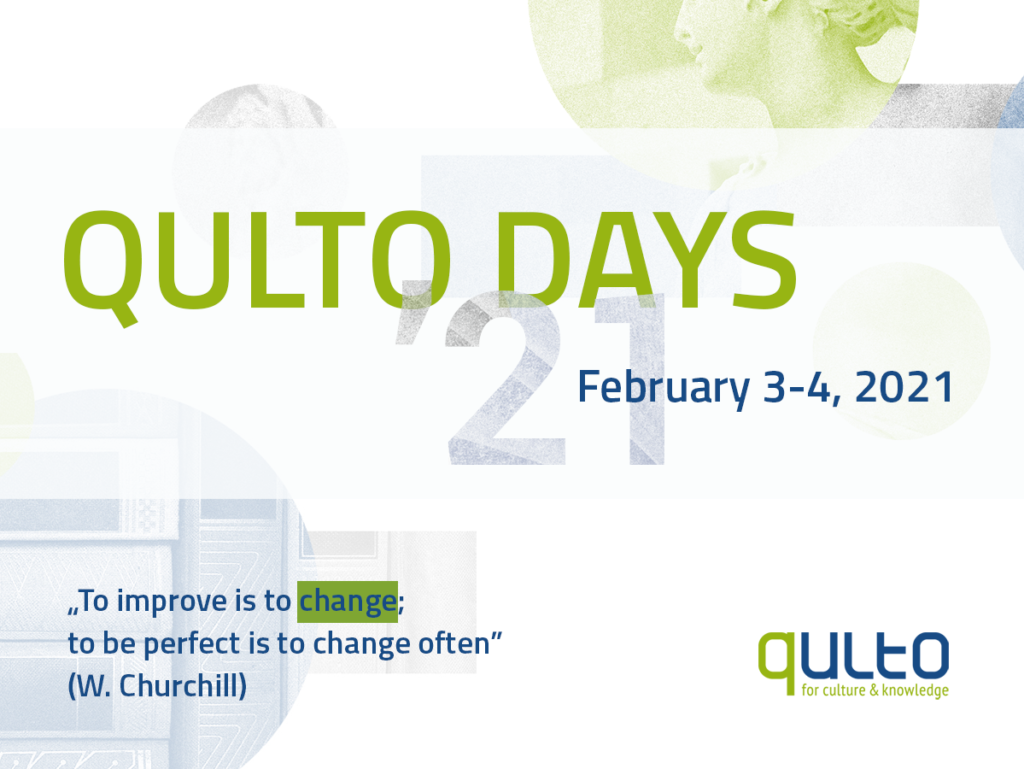
To improve is to change;
to be perfect is to change often.
(W. Churchill)
Join us live for the professional event on February 3 in Hungarian and / or on February 4 in English, where we will talk about exciting projects and current topics. Participation is free, you can register on the form available at the following link: https://tiny.pl/r1rr3
According to our plans, the event will be organized with the help of the Zoom application, the link required for connection will be sent to the registrants in the days before the event.We look forward to hearing from you!
Join our iconic event straight from your couch!:)
As the summer of a most challenging year is over, September brings us a great opportunity to continue doing what we know best: develop meaningful solutions and projects for libraries and other cultural institutions.
In order to do that, we need to hear from you, dedicated librarians and other professionals from the cultural sector: what are your needs, your most daring dreams but also the biggest issues that your organizations are facing nowadays. That is why we are excited to announce our involvement in the upcoming Occupy Library conference, an online event that will take place between September 22-25.
Occupy Library is an informative event bringing together relevant voices for the future of libraries from Central, Eastern European, Black Sea, Caucasus, and Caspian regions. Among the conference’s core themes you can find some vital aspects for nowadays libraries: serving communities in times of crisis, emerging tech trends, public spaces and community engagement. The event is a great opportunity for sharing ideas and good practices on how libraries can improve the lives of the communities they serve. Given its international attendance, the language of the event will be English.
Qulto is proud to be one of the partners of this event. Within the conference, we invite you to visit our 2 booths: a static one, where we will broadcast presentations of our most relevant solutions and projects developed with and for the cultural sector, but also a dynamic one, where you can meet us virtually and participate in workshops and networking events.
So save the date and join us for this exciting event. We are looking forward to meeting you. Registrations will be open in a few days, so don’t forget to register via the conference website. The attendance is free of charge.
During the next few weeks, we will keep you updated on the topics and projects that we plan to share with you during the conference.
Find out more about the conference on their website and keep up with all the news on their Facebook page.