Archive for the ‘Digital’ Category

Qulto Professional Day 2026 – Summary

Posted on: March 4th, 2026 by Papp Ildikó

Qszn 2026 Regisztracio Gform

Repository, RAG, AI – how is access to knowledge changing?

Repositories are the “fuel” of AI, but only if they are refined.

On February 25, 2026, we held our next Qulto Professional Day, the central theme of which was repository developments and the advancement of AI.

Qszn2026 12
Qszn2026 Fszek 2
Qszn2026 03
Qszn2026 02
Qszn2026 13
Qszn2026 04
Qszn2026 05
Qszn2026 01
Qszn2026 11
Qszn2026 10
Qszn2026 08
Qszn2026 07
Qszn2026 06
QSZN2026_12
QSZN2026_FSZEK_2
QSZN2026_03
QSZN2026_02
QSZN2026_13
QSZN2026_04
QSZN2026_05
QSZN2026_01
QSZN2026_11
QSZN2026_10
QSZN2026_08
QSZN2026_07
QSZN2026_06
previous arrow
next arrow
QSZN2026_12
QSZN2026_FSZEK_2
QSZN2026_03
QSZN2026_02
QSZN2026_13
QSZN2026_04
QSZN2026_05
QSZN2026_01
QSZN2026_11
QSZN2026_10
QSZN2026_08
QSZN2026_07
QSZN2026_06
previous arrow
next arrow
Shadow

Presentations

The professional day was opened by the year-evaluation and greeting of Miklós Czoboly, CEO of Qulto, in which he outlined the company’s developments over the past year and its future strategic directions. Following this, representatives of the Metropolitan Ervin Szabó Library (FSZEK) presented the Budapest Electronic Archive, illustrating how local memory can be preserved in the digital space, involving the local community as well. In the series of technological innovations, a prominent role was given to the new Discovery interface and the OPAC Dashboard, which are intended to increase the efficiency of individual research work and user experience with various lists, workbooks, and integrations..

In the second half of the program, specific content service solutions came to the fore, such as ELTE’s DSpace-based course material repository, where reusable content for instructional work (with AI integration) became a priority goal. In addition, we could learn details about the creation of the Baptist Knowledge Base as a repository, which is intended to collect sources, manuscripts, contents, and catalogs scattered around the world and provide them through specific portals.

In the technical sections, Qulto’s specialists presented the latest developments of the integrated library system (IKR), including electronic document access. One of the most current presentations of the day was about the practical application of artificial intelligence in data migration processes, demonstrating how AI is able to relieve professionals from monotonous workflows or perfect the result.

The professional presentations can be accessed on the FSZEK YouTube channel.

Panel Discussion

We explored the topic of the panel discussion – “Synthesis instead of search – How AI is rewriting access to knowledge?” – with László Balázs (FSZEK), Zsolt Bánki (MNL), László Nemes (ELTE), and István Szekrényes (DH-LAB, DE). The starting premise is that without a structured dataset, AI is only a blind tool, therefore public collection databases and repositories that can be considered authentic sources are crucial. But what can make a database a flexible knowledge base, how far are we from a semantic turn in the foyer of AI, and do we even still need to translate existing catalogs and collections into semantic databases? AI would save us huge human resources in this, while the new technology could even comb through different sources at any time in real-time, so we might not even need a separate national catalog anymore, which is of course an extreme end (LB)..

Qszn2026 14
Qszn2026 Fszek 6
Qszn2026 Fszek 7
Qszn2026 09
QSZN2026_14
QSZN2026_FSZEK_6
QSZN2026_FSZEK_7
QSZN2026_09
previous arrow
next arrow
QSZN2026_14
QSZN2026_FSZEK_6
QSZN2026_FSZEK_7
QSZN2026_09
previous arrow
next arrow
Shadow

The obsolescence of the MARC standard was mentioned, but at the same time, the conclusion was that there is currently no better or more suitable standard. If, nevertheless, AI performs the transcription and data enrichment of MARC records, would we dare to let it write into the catalog automatically without human validation, and what will happen to professional credibility then? It is not the goal for the librarian to become a kind of model-checker, but the future is hard to predict, how everything will transform in the profession, the discussion partners believed. Zsolt Bánki emphasized that it is not the job of public collections to decide every professional question, nor to validate AI results one by one, for example, but they must at least provide the data with a marker if it comes from AI and put a confidence level next to it.

The vectorization of databases led to the technology of RAG (Retrieval Augmented Generation), i.e., source-based answer generation, which is a kind of “leash” for AI, as it can only search for answers in the knowledge base specified by us, excluding hallucinations. However, they did not state firmly that the marriage of the semantic database and vector-based search could even be the solution, a kind of holy grail. What they did state, however, was that not only has the time come, but it would have been time long ago to teach semantic modeling alongside cataloging in library-informatics education.

The advantage of RAG + AI technology is the preservation of authenticity, but the disadvantage is that it also limits; the question arose whether it is worth it for public collections to build small language models trained on their own, closed repository data (such as the DH-LAB handwriting recognition project), or should we give our structured collections to a tech giant if, in exchange, readers and researchers would get, for example, a perfect search engine. There is no clear yes/no answer; both can have advantages, but it was stated that every institution must make a clear decision on this in the near future.

If we approach the topic from the perspective of users, the question is whether our search engines will transform. According to an impromptu “survey” measured among the audience, we are moving toward search engines transforming from complex search fields and filters toward a simple chat window direction. It was mentioned that the desirable development could be a kind of hybrid version, with an AI assistant (LB), i.e., the solution already known at Google: an AI-generated summary in the first place and the traditional hit list below it. Therefore, it is necessary to keep the traditional keyword search and put the new generation search function next to it, when the reader or researcher can chat with the knowledge base.

The present, however, is that for now, the first public collection AI projects are starting, which aim at the processing and making visible of collections and repositories, and not necessarily the serving of end-user convenience. Public collections preserve cultural heritage for the future, and currently, their job is to pass it on in such a way and form that future generations will also be able to interpret it.

A question from the audience also highlighted the generational difference in attitude: search fields or chat windows, both initiate a text search, but what about searching with voice and images? For Generation Alpha, seeking information is not necessarily an intentional process, but rather a multimodal experience. The technology is given; the challenge is much more bringing collection data into a “ready-to-speak” format.

The repository presentations and the discussion of the professional day highlight well that public collections represent a secure, structured data foundation (even in the sometimes-labeled-obsolete MARC), on which a vector-based, AI-based search layer can be built; this combination serves both the flexibility of databases and user convenience. The only question is, considering that the capability of artificial intelligence multiplies twenty-six times annually, if we sit down at a round table in the same way in 2 years, what will we be talking about?
Qulto Professional Day 2026

Posted on: February 2nd, 2026 by Papp Ildikó

Qszn 2026 Fb Poszt

At our 2026 event, AI and our latest developments will take center stage.

Let’s meet in person on February 25, 2026, in the Ballroom of the Metropolitan Ervin Szabó Library!

Personal participation in the professional day is free of charge but subject to registration.

Registration

In addition to personal participation, there will be an opportunity to follow the professional presentations indicated in the program from 10:00 to 12:15 online on the library’s YouTube channel. Registration is not required to follow the online broadcast. We count on your participation in this form as well!

We look forward to welcoming all interested parties!

Qulto Team

Program

09:30 – 10:00 Registration, coffee

10:00 – 11:20  Section I.

10:00 – 10:20 Greeting, Year-End Review (Miklós Czoboly, CEO, Qulto)

10:20 – 10:40 Local memory in the digital space: the Budapest Electronic Archive (Ágnes Kovácsné Koreny, Director General, and Zoltán Csámpai, Head of Department, Metropolitan Ervin Szabó Library)

10:40 – 11:00  What can the new Discovery do? — Supporting individual work on the OPAC Dashboard interface (Gábor Deák, Head of Development, Qulto; and Adrienne Szabó, Zoltán Dér, SZTE) 

11:00 – 11:20  New opportunity in managing and sharing educational content: the ELTE course material repository (Tibor Móring, research support librarian, EDIT administrator, ELTE)

15 min break

 11:35 – 12:15 Section II.

11:35 – 11:55  Content services from the Baptist Knowledge Base (Zoltán Bagi, Director, Győr City Archives; and János Pancza, Portfolio Manager, Qulto)

11:55 – 12:05  Electronic document access and other developments in the Qulto ILS (Melinda Mátyás, Product Owner, Qulto)

12:05 – 12:15  “What is your command, dear master?” – The rise of AI in data migration workflows (Monika Lengyel, Head of Customer Support, Qulto)

12:15 – 13:00  Sandwich lunch, meeting with Dániel Reggő (Libri Talent Award)

13:00 ~ 14:45 Interactive debate and exhibitors

Large Ballroom – Interactive debate: “Synthesis instead of search – How AI is rewriting access to knowledge?” Invited participants:

Small Ballroom – we welcome those interested for professional discussions at four booths:

We reserve the right to change the program!

Data Repository Service Launched at SZTE

Posted on: January 13th, 2026 by Papp Ildikó

Szte Adatrepo

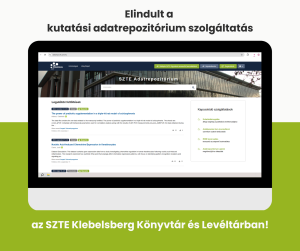
Starting from autumn 2025, the new research data repository of the University of Szeged has been launched through our company’s development, representing a milestone in the institution’s digital ecosystem. The platform, implemented in close cooperation with the SZTE Klebelsberg Library and Archives, aims for the professional storage, organization, and long-term preservation of the vast data assets generated during research. The system follows international FAIR principles, ensuring that uploaded data packages are easy to find, accessible, and reusable for the scientific community. One of the greatest advantages of the development is that every data package receives a unique DOI identifier, which significantly increases the visibility and citation rate of researchers’ publications.

The data repository is not merely a storage space, but also the foundation of a modern knowledge base, offering a personalized dashboard interface and an intelligent recommendation system for researchers and students. User convenience is supported by extra functions such as online annotation, a built-in text translator, or the visual fine-tuning of digital content. University citizens can easily use the system with their own SZTE ID, where they can flexibly manage the accessibility of their uploaded data.

We are proud that our solution contributes to increasing the visibility of university research and the preservation of scientific data assets. The scalability of our solution guarantees that the system will be able to serve dynamically growing data demands in the future. We remain committed to the development of innovative research support technologies for the scientific success of our partners.

The Power of UGC in Public Collections – webinar

Posted on: November 19th, 2025 by Papp Ildikó

Fb Esemény Ugc Webinár

We cordially invite you and your colleagues to our upcoming webinar, the theme of which is an increasingly important field today: the role of User Generated Content (UGC) in museums and libraries.

How can a passive visitor become an active creator? In what ways can the knowledge of the community enrich a collection? In our webinar, we present international and domestic best practices, exploring the intersection of user content and collections through specific examples and a panel discussion.

From Visitor to Creator: The Power of Community Content (UGC) in Public Collections – The Identity Project of The Mountainous Banat Museum in Reşiţa, and a Panel Discussion on Domestic Experiences

December 3, 2025, 10:00 – 12:00 (CET) online webinar 

Participation in the professional discussion is free of charge; registration is possible through the form available here. Deadline for registration: December 2, 12:00

Registration

Program

Invited participants:

Host and moderator of the program: Hedvig Brada

Join us and let’s rethink the relationship between public collections and visitors together!

Registration

ARP Conference

Posted on: October 28th, 2025 by Papp Ildikó

Our colleague, Zoltán Kanász-Nagy, had the opportunity to present at the ARP Annual Conference on October 8, 2025, during the morning session, regarding the InvenioRDM-based data repository recently completed for the University of Szeged (SZTE).

Arp Konf 02
Arp Konf 03
Arp Konf 04
Arp Konf 05
Arp Konf 06
Arp Konf 01
arp_konf_02
arp_konf_03
arp_konf_04
arp_konf_05
arp_konf_06
arp_konf_01
previous arrow
next arrow
arp_konf_02
arp_konf_03
arp_konf_04
arp_konf_05
arp_konf_06
arp_konf_01
previous arrow
next arrow
Shadow

In the event’s opening speech, Katalin Sebők from the HUN-REN Headquarters stated that they consider openness and the exploration of best practices regarding data repositories to be of great importance. It is also commendable that a data steward community appears to be forming in the country, in which HUN-REN’s organizational work regarding the Data Steward Network and its regular events play a vital role.

In the second half of the greetings, Judit Gárdos, a staff member of the ELTE Centre for Social Sciences, reviewed the past four years of the development of research data management in Hungary. She highlighted that 22 data stewards are currently working in the HUN-REN data steward network, for whom internal training has been developed. These specialists interviewed more than 200 researchers, partly motivated by the strive to build community and personal connections, as in this constantly changing world, a relationship of trust can provide a kind of stability.

Following this, our colleague Zoltán Kanász-Nagy presented some “behind-the-scenes” secrets of SZTE’s new InvenioRDM-based data repository: his presentation focused on the technical solutions providing framework customization and unique features. InvenioRDM is an open-source repository framework developed by CERN, specialized for research data, compliant with FAIR principles, and based on Python and React. Its advantages include supporting both DataCite DOI integration (allowing the creation of a DOI simultaneously with the item upload) and the use of the open Research Organization Registry (ROR) database (which facilitates the entry of funding data). Additionally, it is capable of OAI-PMH connection, version control of uploaded files, and even displaying previews of zipped folders. Significant effort had to be invested in the framework to develop permission management suitable for SZTE, adjust the appearance to the institutional identity, and implement Azure-supported SSO login. Unique solutions were created for fine-tuning forms by scientific field, and a custom tool was developed to support future form editing. The user interface was not yet available in Hungarian, so the Hungarian translation was completed using the Transifex tool through the collaboration of our company and university staff, which has also been made available to the domestic community.

In the next presentation, Szabolcs Hoczopán from SZTE spoke about the first experiences of the implementation. He stated that the system has been live since September 2025, while the previous test system remained as a ‘sandbox’. After the start of use, as is typical, a few bugs and requirements emerged, but these were successfully managed together with the development company. Based on initial lessons learned, the login and upload options were given extra prominence on the interface, as these were not as emphasized in the base system. A continuously updated guide on using the system was also prepared for users. Their long-term ambition with the data repository is that, having fulfilled the requests shown in their needs assessment through its creation, it should also become part of the European data repository infrastructure.

As the next speaker, László Kovács, a staff member of SZTAKI and ARP, spoke about the future and development directions of ARP, including their experiments involving the use of AI.

Balázs Horváth, a staff member of the HCSO (KSH), presented the statistical library’s search for its future role, given that some European Union countries have abolished or are planning to abolish their statistical libraries.

János Mohácsi, from Pro-M, gave a presentation on interoperability between research infrastructures, various identity management services, and their technical solutions.


European Museum Academy conference

Posted on: October 21st, 2025 by Papp Ildikó

In 2023, the Hungarian Money Museum and Visitor Centre won the DASA Award from the European Museum Academy, recognizing excellence in museum education. At the organization’s request, the Money Museum was able to participate as a co-organizer in the planning of the conference and award ceremony held in 2025. On the final day of the international conference, held between September 25 (Thursday) and September 27 (Saturday), a workshop titled “Digital Challenges and New Opportunities in the Museums” took place, to which our colleague András Simon was invited as one of the two Hungarian speakers.

Digital Challenges 2
Digital Challenges 1
Digital Challenges 3
Digital Challenges 4
Digital Challenges 5
Digital_challenges_2
Digital_challenges_1
Digital_challenges_3
Digital_challenges_4
Digital_challenges_5
previous arrow
next arrow
Digital_challenges_2
Digital_challenges_1
Digital_challenges_3
Digital_challenges_4
Digital_challenges_5
previous arrow
next arrow
Shadow

He delivered his English-language presentation under the title “User Generated Content in public collections.” Perhaps the most frequently recurring theme among the presentations given at the conference was storytelling. According to the speakers, museums can no longer be satisfied with merely preserving and presenting objects—although this remains the primary mission of these institutions—but they must also present and tell the stories connected to the objects, both on-site and for virtual visitors. Furthermore, these stories connected to objects must not only be told but also collected, thereby saving the community’s memories for posterity. This is why content created by users, User Generated Content (UGC), is so important in modern museum work, and particularly during its digital support.

(Image sources: Money Museum, Monguz Kft.)

Networkshop 2023

Posted on: April 27th, 2023 by Papp Ildikó

“With new technologies and new content for the digital transformation of the future”

NETWORKSHOP, the most prestigious Hungarian conference on computer networking and IT applications for higher education, public education, research and public collections, was held for the 32nd time in Veszprém, Hungary, between 12-14 April 2023.

Our company, as one of the sponsors of Networkshop, was represneted by 11 participants. Our colleagues contributed to the programme with technical presentations, in addition to active participation in the lecture sessions. Gábor Deák, head of the development department and Melinda Mátyás, public collection expert, presented the development of our eCard application in the poster session. Besides the presentation of the poster, a lively discussion evolved among participants on topics such as library standardisation, the technologies used in eCard and the future possibilities of creating book recommendations.

András Simon, client manager, presented in session III.07 Born Digital content management in public collections “Where can I write the inventory number? Born digital documents in collection management practices”, in which he addressed timely issues of altering library and museum practices. Today, a significant proportion of library and museum documents are already digitally generated and other parts of the collection are being digitised at great pace in all heritage institutions. The storage, preservation and servicing of these objects raises a number of issues for which new preservation and servicing strategies need to be developed to replace or complement the tried and tested solutions that have been in use in the past three centuries.

Networkshop_2023_ecard
Networkshop_2023_01
Networkshop_2023_02
Networkshop_2023_041
Networkshop_2023_03
Networkshop_2023_ecard
Networkshop_2023_01
Networkshop_2023_02
Networkshop_2023_041
Networkshop_2023_03
previous arrow
next arrow
Networkshop_2023_ecard
Networkshop_2023_01
Networkshop_2023_02
Networkshop_2023_041
Networkshop_2023_03
previous arrow
next arrow
Shadow

Qulto RI on NRDIO site

Posted on: January 21st, 2023 by Papp Ildikó

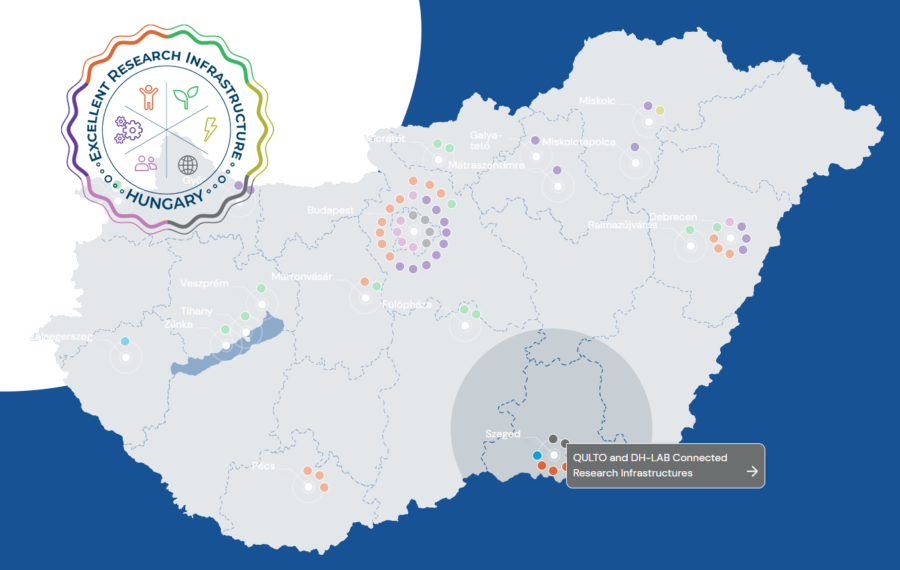
We are visible! 👀 Proud to have the Qulto Research Infrastructure been put up on the map, among the Excellent Research Infrastructures and Infrastructure Clusters in Hungary.

Qulto_RI_hirThe Qulto Research Infrastructure (Qulto RI) is a distributed and virtual, domain-independent research infrastructure that provides essential support for the digitization, storage, organization, retrieval, publication, reuse, and search for relevant sources and plagiarism of higher education and research content in Hungary.

Main pillars of the Qulto RI are
🗸 Digitize
🗸 Discovery
🗸 SimilR
🗸 Repo

Want to have more insight into the collaboration of Qulto and ELTE DH, and the services offered by the connected infrastructures? Visit here!